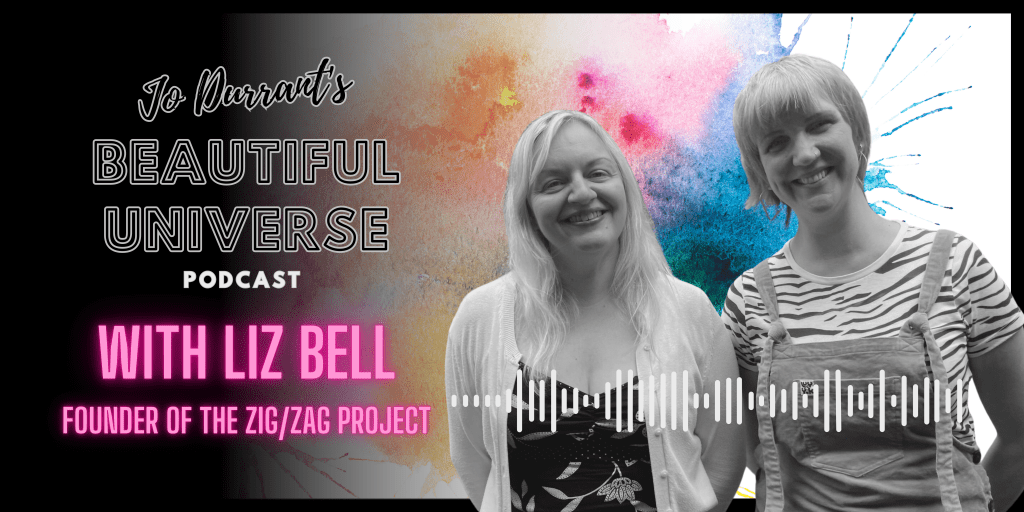
Sometimes talking about ourselves is hard. But taking a risk and opening up can be transformative, as ZIG/ZAG founder Liz Bell discovered when she was invited to be a special guest on the award-winning science and arts podcast, Jo Durrant’s Beautiful Universe.

As someone who is far more comfortable asking questions than answering them, nothing is guaranteed to make me freeze up more than that classic ice-breaker question, “Tell us a bit about yourself.”
I mean, what are you even supposed to say to that?! How is anyone able to condense their own immensely complex and entirely subjective experience as a human being into a snappy, 2-minute elevator pitch? Without knowing why the question is being asked, I find it’s impossible to give an answer that contains enough relevant information without also overwhelming the listener with excessive or inappropriate detail.
So when veteran journalist and podcaster Jo Durrant invited me to be a special guest on an episode of her award-winning arts and science podcast, Jo Durrant’s Beautiful Universe, I was deeply apprehensive.
What if I messed it up? What if I came across as really boring? Or worst of all, what if I came across as a complete dick?! While I love talking about the abstract concept of neurodiversity, the idea of talking about myself – for a whole hour! – filled me with anticipatory dread.
But having previously met Jo in her capacity as a BBC radio journalist, I had complete faith in her editorial skills. I also knew the reputation and reach of her podcast represented a fantastic opportunity to promote ZIG/ZAG to a wider audience, so I bit the bullet and agreed to do it.
On the day of the recording, Jo came to my house, where we sat in my kitchen, overlooking my scruffy oasis of a garden. And then we talked – not only about The ZIG/ZAG Project, but about so much more as well.
We talked about the myth of the ‘career path’ – and how professional progression is rarely linear when you are driven by curiosity.
We talked about the impossible standards to which those of us who have been socialised as women are held at every stage of life, and how poetry and art can help us reframe – and reclaim – our own narratives.
We talked about the joy that can be found in embracing our own unique style of learning – whether it’s about ants or trees or people or ideas or networks – and what it might look like for neurodivergent people to thrive in a world that is frequently so hostile towards non-conformity.
Afterwards, the self-consciousness crept back and I began to worry about how I had come across. As a writer, I’m used to editing my thoughts before sharing them, so I felt wildly vulnerable knowing my unfiltered words were now in someone else’s hands.
By the time Episode 149 of Jo Durrant’s Beautiful Universe was released yesterday, I was ready to pop with the suspense. And, despite having convinced myself that it was going to be the world’s most cringe-inducing experience, I genuinely enjoyed listening back to the interview.
I’ve always tried to keep a distinct line between me-as-an-activist and me-as-a-person. I’ve avoided talking much about my own individual experience of neurodivergence, focusing instead on exploring new ways to collectively challenge neuronormative standards and expectations.
But it turned out to be unexpectedly validating to reflect upon my own neurodivergence as not just an abstract concept, but as something that is inextricably linked to my entire professional and artistic practice.
It doesn’t matter that I’m not the world’s most articulate public speaker, or that verbal processing doesn’t come as fluently to me as writing. Because, in letting go of the sense of control I get from being able to review and edit my words on a page before sharing them with the world, I’m finally beginning to believe that I have something worth saying.
You can hear Liz’s interview on episode 149 of Jo Durrant’s Beautiful Universe podcast, which is also available on Apple Podcasts here.
 ZIG/ZAG
Leave a comment